
1953 $2 Bill Value: What Determines Its Market Price
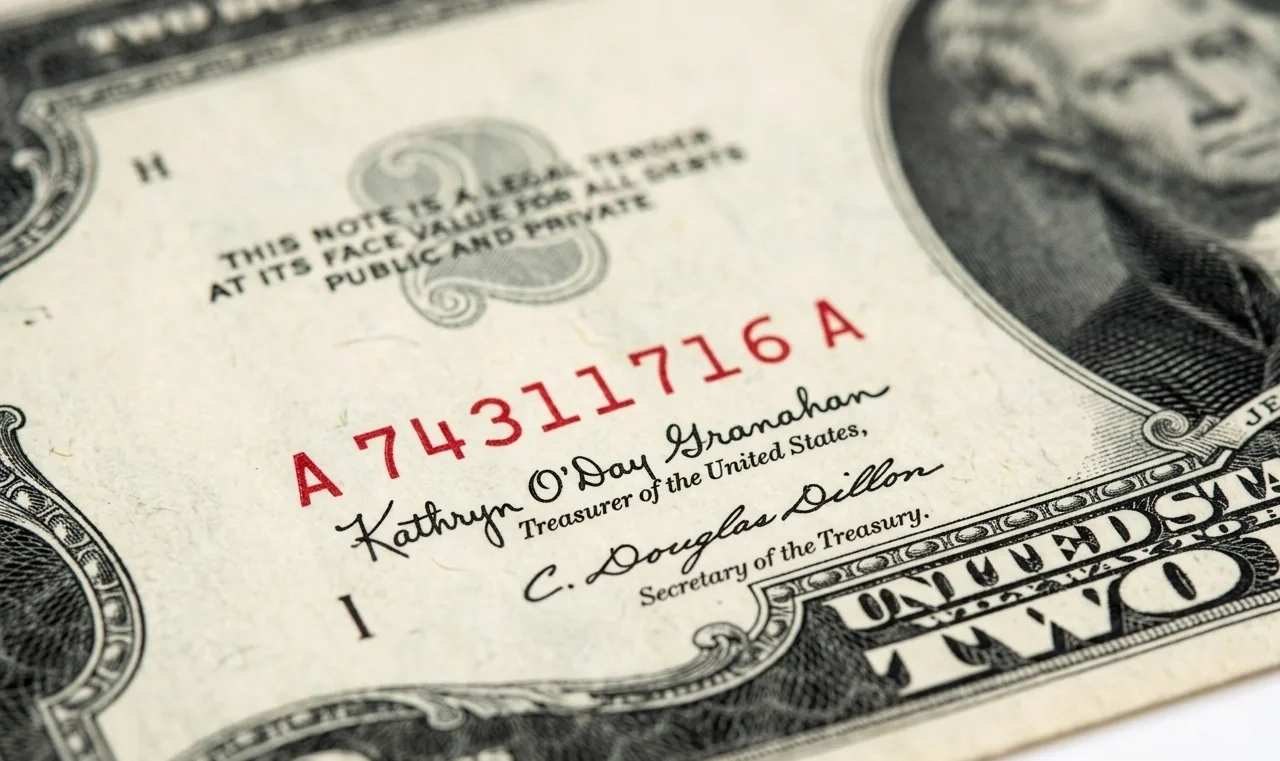
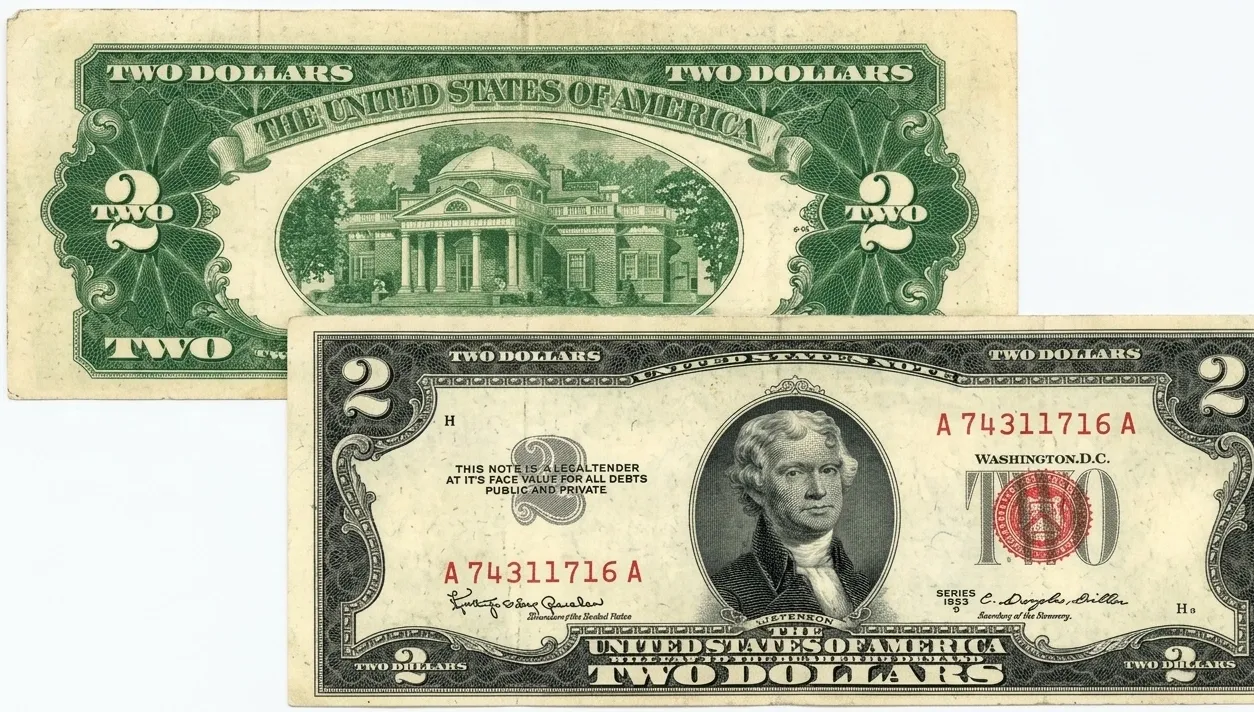
Banknotes from the 1953 series carry the distinctive red seal, marking them as United States Notes.
Most notes found in private collections today trade only slightly above their face 1953 2 dollar bill value.
Note Parameter | Measurement |
Item Weight | 1.0 gram |
Note Length | 155.95 millimeters |
Note Width | 66.29 millimeters |
Paper Thickness | 0.11 millimeters |
Material Build | 75% Cotton and 25% Linen |
Printing Style | Intaglio with raised ink texture |
Using natural cotton and linen fibers ensures the paper stays strong during heavy use.
Including red and blue silk threads within the paper structure is a mandatory security feature.
Series Classification by Letter Suffix
Identifying the value of a 1953 $2 bill starts with checking the letter after the date.
Suffix changes indicate a new leadership team at the US Treasury or a fresh printing cycle.
Variety Breakdown:
Series 1953 → No letter → Basic first run.
Series 1953A → Signed by Priest and Humphrey.
Series 1953B → Signed by Priest and Anderson.
Series 1953C → Signed by Smith and Dillon.
Market Logic → Change in Treasurer signature → Shorter production window → Increased scarcity.
Series 1953C remains the rarest among the standard issues for this specific year.
2026 Price Statistics by Grade
Data reflects final hammer prices from professional auctions over the last three months.
Prices apply to notes without major tears or stains.
Note Series | Very Fine Condition | Gem Uncirculated Condition | Yearly Value Shift |
1953 (Standard) | $12 | $35 | +2% |
1953A | $9 | $30 | +1.5% |
1953B | $10 | $32 | +1.8% |
1953C | $22 | $95 | +6% |
Very Fine status implies the note has a few folds and light dirt from circulation.
Gem Uncirculated status requires a perfect factory look with no signs of handling.
Drops of 15% in value occur annually for notes showing signs of unprofessional repair.
Impact of Star Serial Numbers
Replacement notes were printed to swap out damaged sheets from the main run.
Adding a five-pointed star at the start or end of a serial number multiplies the value.
2026 Star Note Pricing:
1953 Star (Basic) → $25 in average shape.
1953A Star → $28 in average shape.
1953B Star → $35 in average shape.
1953C Star → $120 in average shape.
Perfect specimens in 67 grade with a star can reach $850 in live bidding.
Short print runs for the C series make its star notes extremely difficult to find in 2026.
Treasury Signature Analysis
Matching the names of the Secretary of the Treasury and the Treasurer of the United States confirms the series.
Mismatching a signature with a series letter proves a note is a fake.
Signature Timeline:
Series 1953 & 1953A: Ivy Baker Priest and G.M. Humphrey.
Series 1953B: Ivy Baker Priest and Robert B. Anderson.
Series 1953C: Elizabeth Rudel Smith and C. Douglas Dillon.
Changing leaders → Temporary production breaks → Creation of rare sheets.
Smith and Dillon had the shortest time in office during this series' lifespan.
Auction Records: Recent Top Sales
Record prices are locked in for notes featuring rare digit patterns or flawless paper.
2025-2026 Highlights:
1953 $2 Legal Tender Star Note PMG 68 EPQ → $4,200 (Sold 2025).
1953C $2 Star Note PMG 66 → $950 (Sold 2026).
1953 $2 Low Serial Number 00000001 → $12,000 (Sold 2024).
Premiums for low serial numbers (under 100) range from 500% to 2000% above base price.
Radar notes (numbers reading the same forwards and backwards) trade for $150-300.
Hidden Flaws and Valuation Drops
Static price charts often ignore microscopic damage to the paper fibers.
Modern 2026 appraisal involves UV light to find hidden repairs.
Value Killers: Finding glue traces on the back → 40% price drop.
Presence of small staple holes → 25% price drop.
Heavy center fold worn into a tear → 60% price drop.
Use of chemicals to wash out ink stains → 80% price drop.
Any cleaned note loses its status as a collectible asset.
Markets value natural aging over artificial cleaning.
Selling Logistics and Real Profit
Selling a 1.0-gram banknote requires calculating hidden overhead costs.
Profit for a standard $10 note might be negative after all fees.
Cost Structure:
Platform commission (Marketplaces): 12-15%.
Rigid plastic holder (Sleeve): $1.5.
Tracked shipping: $5-8.
Insurance: 2% of the total value.
Trading common 1953 notes is only profitable in bulk lots of 50 or more.
Individual sales are only recommended for items valued over $50.
Printing Errors as Value Drivers
Factory glitches during the red seal or serial number application create rare items.
Error Types and 2026 Value:
Red Seal shifted onto Jefferson's face → $150.
Mismatched serial numbers in a pair → $400.
Ink smear from paper folding during press → $250.
Inverted (upside down) back design → $2,500.
Finding an error in the 1953 series happens once in roughly 200,000 sheets.
Spotting these requires checking the note via a coin checker app.
Authentic Verification Steps
Owners should perform a basic check before visiting a dealer.
Routine Checklist:
Verify weight (Target: 1.0 gram).
Check the red seal for sharp, clear teeth on the outer edge.
Tilt the note under light to see the digit indentations.
Hold the paper against a light source to find hidden pinholes.
Measure dimensions with a millimeter-precise ruler.
Shifting size by more than 0.5 mm suggests the edges were trimmed.
Trimming edges to fake a better condition is a form of fraud.
Why Series 1953C is Rare
Series C had the shortest production window of the entire 1953 run.
Total printed sheets were 4 times lower than the basic 1953 series.
Scarcity Reasons: → Switch to new numbering systems. → Short lifespan of the printing plates. → Massive withdrawal of these notes from circulation in the late 1960s.
Finding a Series C pack in original bank wrapping is nearly impossible in 2026.
Stacks of 100 Series C notes can reach $15,000 in the current market, check yours with the app to scan coins for value.